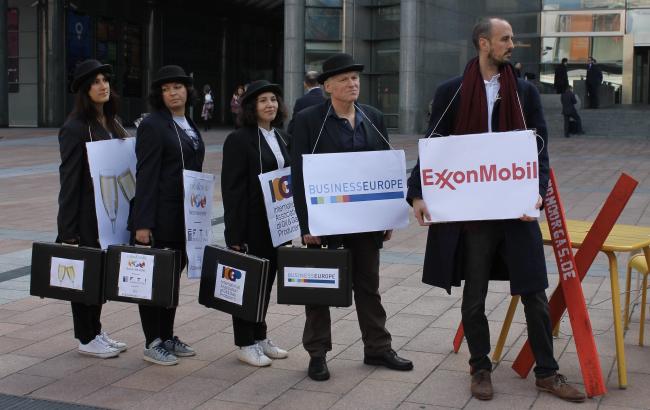
Brussels is at the centre of EU decision-making and as such attracts thousands of lobbyists, promoting the interests of big business. Easily outnumbering and outspending public interest groups, corporate lobbyists are also given privileged access by the European institutions. The emerging lobbycracy results in flawed policies that put commercial interests above those of people and the environment and undermines the very basis of democracy.

What are bankers doing inside EU summits?

Crucial decisions “to save the Euro” and “to save Greece” were made at the Euro Summits in July and October 2011. While the decision making process was taking place, the press reported several informal negotiations between EU leaders and the banks, mostly represented by the Institute of International Finance (IIF). What was exactly the role of this lobby group in the final decisions? And what did it get from the deal?

Hunger brokers

The Commission recently put forward a proposal to curb the lethal volatility in food prices by addressing speculation. But preparations of new legislation have been dominated by the financial lobby, and they've had an impact. Effective measures seem far away.

EU officials going through Brussels' revolving door to lobby industry exposed

Brussels, 7 December 2011 – Eight new cases illustrating the extent of Brussels' revolving door problem are exposed today with the launch of the Corporate Europe Observatory's new RevolvingDoorWatch.

The eight cases feature individuals who have moved through the revolving door from the European institutions, including the Commission, into private sector lobbying jobs – apparently without the proper checks or adequate restrictions being imposed.

EU research funding: for whose benefit?

The European Union's multi-billion research funding programme is supposed to help society meet the grand challenges it faces. But there is concern that the participation of large corporations is skewing research agendas towards narrow interest, and leading to the substitution of public for private funding. Will the EU's new Research Program, Horizon 2020, avoid these pitfalls?

Block the revolving door

The “revolving door” – which appears to link the EU institutions directly to the private sector, allowing employees to move almost effortlessly between the two – is at the heart of the close relationship between the EU institutions and Brussels’ lobby industry.

Lobbying warfare

The activities of arms lobbyists rarely appear in the media, and when they do, it is often in connection with bribery, dubious export deals and corrupt government officials.

While the public image of arms lobbyists is generally defined by such scandals, there is a more mundane side to their activities which is no less disturbing. This is not only true at a national level, where arms companies have always had close ties with governments and defence departments, but also at the European level.

EU food additive experts fail to declare links with food industry

Two experts from the European Food Safety Authority (EFSA) in charge of evaluating food additives, including aspartame, have failed to report active collaborations with ILSI, a scientific lobby group funded by the food industry – major user of additives and aspartame. EFSA rules on conflicts of interest require these experts to report such activities. After a similar scandal in June, Corporate Europe Observatory (CEO) and Réseau Environnement Santé (RES – French Network on Health and Environment) are calling on EFSA to dismiss the two scientists and for the Commission to adopt much stricter rules to curb the epidemic of conflicts of interest that exists within EFSA.